
Wednesday, 4 May 2016
Flower can bring smile in Manipur
For the last 15 years, the flower business has kept my family afloat. The money from selling flowers also goes to support my children’s education. If only the government or the banks helped us through with subsidized loans, we could even have targeted export. There is lot of demand for flowers,plants and even dry flowers from both within and outside the state,
said Nisha Mao, a florist who participated in the Second Flower Festival in Manipur, organized by the Mao Flower Growers’ Association with assistance from the Horticulture department.

Manipur Governor, V Shanmuganathan who inaugurated the Flower Festival, encouraged the Flower Growers’ Association and offered his assistance in promoting floriculture in the state.
 The festival was a huge success, drawing crowds both from Manipur and neighbouring state Nagaland. The rates at which some flower plants were sold at the festival can give an idea about how lucrative floriculture can be for unemployed youths. Regal Pelargonium hybrid at Rs 3,000, seasonal Orchids Rs 2,500, Hydrange Rs 800, Geranium Rs 700, Petunia Night Sky Rs 500, Azalea Rs 500, Alstro Meria Rs 250, Chrysanthemum Rs 250, Rose Rs 250, Carnation Rs 250, Fuchsia Rs 200, Begonia Rs 200, Cenireria Rs 150, Calceolaria Rs 150 and Primula at Rs 100.
Currently there are over 7,00,000 registered educated unemployed youths in the state which has a population of 28 lakh. Unemployment is seen as a major factor for the unrelenting insurgency ravaging the border state. Growing flowers can open up employment avenues for a sizeable number of youths in the state.

This is the reality in frontier state Manipur, identified as a floriculture hotspot. The irony is profound given the fact that the Union Ministry of Commerce and Industry’s plan for a roadmap to promote floriculture in Northeastern states like Sikkim, Nagalnd, Meghalaya,Mizoram and Manipur as India tries to venture into export oriented floriculture by its development in the region.
Altogether 64 florists from all over Manipur took part in the three-day festival from 9th to 11th April at Mao in the hill district Senapati, where over 100 varieties of rare species of flowers were on display. Besides colorful flowers, bonsai plants drew huge crowds at the fair. Manipur is home to rare flora including varieties of flowers and rare orchids. Mao, lying at 1788 metres above sea level, has a vibrant floriculture and horticulture in the station. Situated 100 km from capital city Imphal, Mao is a charming hill station, a must destination for adventure tourists for the trek to its stunningly picturesque valley where the rare Dzuku lilly blooms — surrounded by the rolling hillocks, embraced by rivulets and embellished with amazing rock faces and caves.
Manipur Governor, V Shanmuganathan who inaugurated the Flower Festival, encouraged the Flower Growers’ Association and offered his assistance in promoting floriculture in the state.
The theme of the Flower Festival this time is ‘Colors of Spring’. It is being organized to preserve, promote and develop the gift of Nature endowed upon the land. The festival is aimed at bringing florists of the State closer and uniting them under one forum for their welfare,said Kajichew, convenor of the organising committee.
Floriculture is certainly a way to economic emancipation, especially for a small state like Manipur, endowed with suitable climatic conditions. Some flower species of Manipur are in great demand in Indian metros as well as in international cites like Singapore, Amsterdam and Tokyo. The government must do all it can to tap this sector,said Haridas Sharma, former director of Manipur’s Agriculture department.
 The festival was a huge success, drawing crowds both from Manipur and neighbouring state Nagaland. The rates at which some flower plants were sold at the festival can give an idea about how lucrative floriculture can be for unemployed youths. Regal Pelargonium hybrid at Rs 3,000, seasonal Orchids Rs 2,500, Hydrange Rs 800, Geranium Rs 700, Petunia Night Sky Rs 500, Azalea Rs 500, Alstro Meria Rs 250, Chrysanthemum Rs 250, Rose Rs 250, Carnation Rs 250, Fuchsia Rs 200, Begonia Rs 200, Cenireria Rs 150, Calceolaria Rs 150 and Primula at Rs 100.
Currently there are over 7,00,000 registered educated unemployed youths in the state which has a population of 28 lakh. Unemployment is seen as a major factor for the unrelenting insurgency ravaging the border state. Growing flowers can open up employment avenues for a sizeable number of youths in the state.
Sunday, 3 April 2016
A strange seabird sighted in Manipur - R.K. Birjit Singh
 |
| Jouanin's petrel Bulweria fallax belonging to Procellaridae family |
Obviously, birds are great indicators of the state of change of our environment. Just observing them and recording their behavior can go a long way in understanding the global climate
A strange seabird which had no record of sighting in inland India has been sighted in Loktak Ramsar,(IBA) Toubul village, Manipur on 29th June, 2015. The species has been identified as Jouanin's petrel Bulweria fallax belonging to Procellaridae family. The biometric measurement of the species is 28 cm in length and weighing 150 to 180 grams with a wingspan of 66-70 cm. The species is dark sooty with wedge shaped tail. They are pelagic, marine and natural habitats are open and shallow seas. It has been recorded to breed on Socotra, a small archipelago of four islands in the Indian Ocean, the most alien-looking place on Earth. Further investigation reveals that the species is a Near Threatened (NT) as per Birdlife International Red List of Threatened bird species. Read more
Monday, 21 December 2015
MANIPUR’S ANIMAL DIARY : DEER - Kh. Shamungou and T. Gyaneshori Devi
Manipur is bestowed with its pleasant climatic and topographical
features supporting rich and unique forms of animals. Out of
22,327 sq km of state’s total area, 17418 sq km are under forest covers, which are characteristically
of Himalayan type showing similar gradation from subtropical to temperate
vegetation. The region is well within the Indo-Myanmar biological hotspot and
it has the fauna characteristic of the Indo Himalayan region, the
Malayan type over and above its own endemic species.
Manipur Deer :
Deer belong to the family Cervidae (Order Artiodactyla), a group of
animal whose males bear solid antlers that shed periodically. Manipur
has a legacy of pride for having been the home of four species of
fascinating deer-the Manipur brow-antlered deer, hog deer, sambar
deer and barking deer. The Manipur brow-antlered deer is endemic to
this region.
Manipur Brow-antlered Deer/Eld’s Deer of Manipur :
The Manipur brow-antlered deer (Rucervus eldii eldii, McClleland 1842) lovingly called sangai (Sa, animal and ngai, in awaiting and looking at you) by the people of Manipur is a rare and critically endangered mammal. A rutting male (125cm) has graceful crown of ‘arc’ shaped antlers. The sangai in Manipur is taking its last refuge on the fringe of Loktak Lake (a Ramsar Site, 1990) in a 40 sq km Keibul Lamjao National Park (KLNP) along with hog deer (Axis porcinus), wild boar (Sus scrofa) and several birds. The important features of the KLNP are the presence of floating vegetation called phum or phumdi and three hillocks inside. The rests are waterbodies. Sangai was declared extinct in 1951, however, a small survivor of around 100 heads was discovered again in 1953 by E.P. Gee in Keibul Lamjao area and that has led to the creation of a sangai sanctuary in 1955 and later as a national park in 1977.
The Manipur brow-antlered deer (Rucervus eldii eldii, McClleland 1842) lovingly called sangai (Sa, animal and ngai, in awaiting and looking at you) by the people of Manipur is a rare and critically endangered mammal. A rutting male (125cm) has graceful crown of ‘arc’ shaped antlers. The sangai in Manipur is taking its last refuge on the fringe of Loktak Lake (a Ramsar Site, 1990) in a 40 sq km Keibul Lamjao National Park (KLNP) along with hog deer (Axis porcinus), wild boar (Sus scrofa) and several birds. The important features of the KLNP are the presence of floating vegetation called phum or phumdi and three hillocks inside. The rests are waterbodies. Sangai was declared extinct in 1951, however, a small survivor of around 100 heads was discovered again in 1953 by E.P. Gee in Keibul Lamjao area and that has led to the creation of a sangai sanctuary in 1955 and later as a national park in 1977.
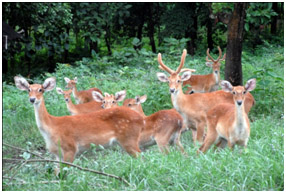 |
| Males in velvet - Photo: Shamungou |
Three sub-species of the Eld’s deer-the Manipur’s sangai (Rucervus eldii eldii, McClleland 1842), Burma’s (Myanmar) thamin (Rucervus eldii thamin, Thomas 1918) and Thailand’s lamang (Rucervus eldii siamensis, Lyddeker 1915) are recognized across the south and Southeast Asia. A fourth sub-species called Rucervus eldii hainanus for a population of around 100 heads now in Hainan (China), is also suggested. The Manipur race of Eld’s deer is distinguished by its well developed hairy hind pasterns and smaller curvature of antlers.
Currently, sangai is awarded as Endangered by IUCN, listed in Appendix I
by CITES and included in Schedule I by WLPA. Today, around 200 heads of sangai
are facing all round threats of habitat destruction, poaching and probably a
genetic disorder too and if the current progress of threats continue, it
may take two or three decades at the most, this endemic species to extinct. Therefore,
it is not preferable to enclose the entire small population of sangai at one place under the fragile
ecological conditions and in order to reduce the risks, efforts to establish off-side
populations are suggested. Read more
Friday, 30 October 2015
Biodiversity of fishes in Manipur - Prof. W. Vishwanath
The diversity of species in the North Eastern India region is attributed to the recent geological history, especially the Himalayan orogeny. Since both the Brahmaputra and Chindwin system of rivers drain Manipur, its fauna included both Asamese and Burmese elements. Though, there is great specific diversity, the genera of the Brahmaputra and the Chindwin drainages are almost the same. Fresh water from the Indian mainland would have migrated towards Myanmar and other parts of south east Asia only then. Thus, the species of fishes in this region probably evolved only very recently from their old gondwanan ancestor. The diversity is attributed to the vigorous movements of earth’s crust and constant changes in the courses of waters.
Threats to Manipur Fishes
The freshwater fishes of the Eastern Himalaya were assessed and evaluated to assign their threat criteria and red listing by the International Union for Conservation of Nature (IUCN) in 2009-10. Out of more than 580 species assessed, 50 were found Vulnerable and 15 were reported as Endangered. Twenty-seven species in Manipur are Vulnerable and 10 (ten) species were Endangered. Of the whole eastern Himalaya, the most threatened fishes are confined in Manipur and its adjoining areas.
 | ||||
| Map Showing Threatened Freshwater Fish Species Richness - IUCN |


Saturday, 25 July 2015
Climate Change and Ecosystem in Manipur
Eco-systems have an inherent capacity to adapt and adjust to the climatic variability as well as to incremental changes in the landscape to a certain extent. When this capacity is exceeded, the eco-system parameters get altered in multifarious ways and become socially and environmentally unsustainable. Ecosystems are well recognized life support systems which are critical factors for human well being. Hence, the importance of the conservation of ecosystem which is veritably subjected to anthropogenic climate change is explicitly highlighted in the Article 2 of the UNFCCC, 1992. The impacts on the ecosystems could lead to loss and migration of rare and endangered species and fragmentation of habitats. Though many of these are medium term impacts but they pose serious consequences especially in species extinction whether globally or locally.
 |
| Forest of Manipur (Senapati Destrict) |
Manipur comes under two of the global bio-diversity "hotspots" viz. Himalayan Biodiversity Hotspot and Indo-Burma Biodiversity Hotspot characterized by eco-systems which are rich in bio-diversity and possess rare and/or endangered species. The projected climatic variability could have adverse impacts on ecologically distinct and rich biodiversity of the region. Therefore, it is crucial, to be cautious about the causal links between biodiversity and ecosystem functioning in the maintenance of ecosystem services. Thus adaptation responses have to be crafted in such a manner that the endangered species are preserved and adverse impacts are minimized as species extinctions whether global or local due to climate change (natural or anthropogenic) bring about irreversible change. Moreover since both the Brahmaputra and Chindwin river systems drain Manipur, the aquatic fauna of the state embodies both Assamese and Burmese elements. Many fish species which were hitherto not recorded elsewhere in India are found only in Manipur. The Manipur River Basin is reported to be under the greatest threat - specifically for the freshwater fish. Out of the fifteen endangered fish species of Eastern Himalayas, eight fish species are reported from Manipur.

The conservation of ecosystem is vital to the ecological security of the state landscape in terms of restoring forest cover, maintaining the sources of perennial water required for drinking and irrigation purposes and sustaining agriculture which in turn is linked to the livelihood of the people. The sustainable management of ecosystem, biodiversity and livelihood requirements must go hand in hand with climate friendly practices and adaptations to the dynamic situation that may arise during execution of the programme. Read more
- T. Brajakumar, Ph.D. (email:
brajakumar_t@yahoo.com)
Tuesday, 9 June 2015
Observance of World Environment Day 2015
World Environment day 2015 was observed on the 5th June under United Nation’s theme “Seven Billion people. One Planet.Consume with care.” at Maharaja Chandrakirti Auditorium organized by Directorate of Environment, Government of Manipur.
 The event was observed to make aware the common public about environmental issues. Environment Awareness Campaign is started to address environmental issues like wastage and losses of food, deforestation, increasing global warming and so on.
Every year,the event is organized according to a given particular theme and slogan of the year to bring effectiveness in the campaign all over the world. read more
Saturday, 30 May 2015
Hill dwellers realizes bird's role in economics of biodiversity
For Kanrei Horam, banning of bird hunting in and around his native Kharasom village in Manipur’s hill district of Ukhrul is simply good news. Because it will help in regenerating Yongchak trees and other agro-resources besides reviving loss habitat of the rare birds in his hill village which is located about 160 km north of state capital. Large scale hunting, use of pesticides, loss of habitat due to deforestation to meet the demands of an expanding population coupled by the changing climatic condition has threatened the rich biodiversity of Manipur hills and rendered certain bird species vanished from its existence in the region. The ban on bird hunting was in force following the villages’ yearly public sitting in January this year. “The reason behind the ban is related with the attack on village crops mostly in Yongchak (Perkia Timoriana) trees by unknown insects”, says 58 year old Kanrei, a key functionary of Kharasom village authority. “The incident(insect invasion) has severely affected Yongchak business last year.” read more
Subscribe to:
Posts
(
Atom
)